
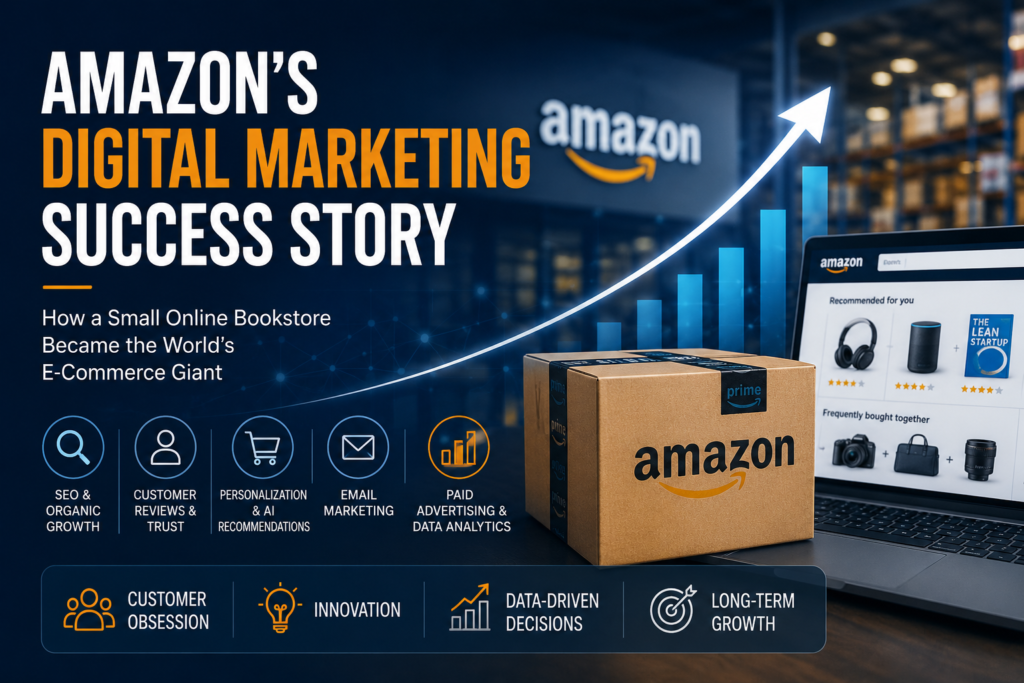
Amazon Digital Marketing Success Story : How Amazon Became a Global Giant
Amazon Digital Marketing Success Story Introduction
Imagine starting a business in a small garage with a simple idea: selling books online.
No massive funding. No global brand recognition. No millions of customers waiting to buy.
Just a vision.
Fast forward a few decades, and that small online bookstore becomes one of the most valuable companies in the world, serving hundreds of millions of customers across multiple countries.
That company is Amazon.
While many people associate Amazon success with logistics, technology, and innovation, another powerful force worked behind the scenes—digital marketing.
Amazon didn’t become a global giant by chance. It built an ecosystem that combined customer obsession, search optimization, personalization, data analytics, email marketing, content marketing, paid advertising, and AI-driven recommendations.
This is the story of how Amazon mastered digital marketing and transformed the way businesses connect with customers.
Chapter 1: The Beginning of a Digital Revolution
In 1994, Jeff Bezos noticed something unusual.
The internet was growing at an extraordinary pace.
While many businesses ignored this new technology, Bezos saw an opportunity.
He asked himself a simple question:
“What product category has millions of options and can be sold effectively online?”
The answer was books.
Books didn’t require customers to physically inspect them before purchasing. Every book had a title, author, description, and ISBN number.
This made books ideal for online selling.
In 1995, Amazon launched as an online bookstore.
However, the challenge wasn’t building a website.
The challenge was attracting visitors.
Without visitors, there would be no sales.
This is where digital marketing began playing a critical role.
Chapter 2: Winning the Search Engine Battle
Long before SEO became a buzzword, Amazon understood the importance of being discoverable online.
Every product page was designed to answer customer queries.
Each book listing included:
- Detailed descriptions
- Product information
- Reviews
- Related recommendations
- Search-friendly content
As search engines evolved, Amazon continuously optimized product pages to rank for millions of keywords.
For example:
When someone searched for:
- Best business books
- Harry Potter collection
- Marketing books for beginners
Amazon pages frequently appeared in search results.
Instead of relying only on advertising, Amazon built a system where customers could find products organically.
Today, millions of Amazon pages rank on Google, generating enormous amounts of free traffic.
This demonstrates one of the most important digital marketing lessons:
Organic visibility creates long-term business growth.
Chapter 3: The Power of Customer Reviews
Most businesses focused on selling products.
Amazon focused on building trust.
One of Amazon most powerful marketing innovations was customer reviews.
At the time, many companies feared negative reviews.
Amazon embraced them.
Customers could openly share opinions, experiences, and ratings.
This created transparency.
Potential buyers trusted other customers more than advertisements.
Over time, reviews became one of Amazon strongest conversion tools.
A product with thousands of positive reviews naturally attracted more buyers.
This strategy generated user-generated content at scale.
Today, reviews remain one of the most effective forms of digital marketing because they create social proof.
Chapter 4: Personalization Changed Everything
Imagine walking into a store where every shelf is customized specifically for you.
The products you love are displayed first.
The recommendations perfectly match your interests.
That is exactly what Amazon achieved online.
Using customer behavior, browsing history, purchase history, and preferences, Amazon built one of the world’s most sophisticated recommendation systems.
Customers began seeing suggestions such as:
- Frequently bought together
- Customers also bought
- Recommended for you
- Inspired by your browsing history
This personalization strategy dramatically increased engagement and sales.
Instead of forcing products on customers, Amazon helped customers discover relevant products naturally.
The result was a better shopping experience and higher revenue.
Chapter 5: Email Marketing at Scale
Many businesses send promotional emails.
Amazon transformed email marketing into a science.
Rather than sending identical emails to everyone, Amazon segmented audiences based on behavior.
Customers received:
- Product recommendations
- Cart abandonment reminders
- Special offers
- New product launches
- Personalized suggestions
Every email felt relevant.
If someone purchased a camera, Amazon recommended lenses and accessories.
If someone browsed books about entrepreneurship, Amazon suggested related titles.
This data-driven approach increased email engagement and conversions.
The lesson is simple:
The more relevant your marketing, the better your results.
Chapter 6: Content Marketing Without Looking Like Marketing
One reason Amazon succeeds is that much of its content doesn’t feel like advertising.
Instead of constantly pushing products, Amazon provides information.
Product descriptions answer questions.
Reviews provide insights.
Buying guides help customers make decisions.
Comparison features simplify research.
This content-first approach creates trust.
Customers feel informed rather than pressured.
Modern businesses can learn an important lesson here:
The best marketing often feels like helpful information rather than promotion.
You will be also like to read :- Amul Digital Marketing Case Study
Chapter 7: Building an Advertising Ecosystem
As Amazon grew, it realized that brands wanted visibility on the platform.
This led to the creation of Amazon Advertising.
Brands could promote products directly to shoppers who were already searching for solutions.
This created a powerful advantage.
Unlike traditional advertising, Amazon ads targeted users with strong buying intent.
A person searching for “wireless headphones” was already interested in purchasing.
This made advertising more effective and profitable.
Today, Amazon Advertising generates billions of dollars and has become a major competitor to Google and Meta.
Chapter 8: Mobile Marketing and Convenience
The rise of smartphones changed consumer behavior.
Amazon adapted quickly.
The Amazon mobile app provided:
- Easy browsing
- Personalized recommendations
- One-click purchasing
- Real-time tracking
- Push notifications
Every aspect of the user experience was optimized for convenience.
The easier it became to shop, the more customers purchased.
This demonstrates a critical marketing principle:
Reducing friction increases conversions.
Chapter 9: The Prime Membership Strategy
One of Amazon greatest marketing achievements is Amazon Prime.
At first glance, Prime appears to be a subscription service.
In reality, it is a customer retention strategy.
Prime members receive benefits such as:
- Fast delivery
- Exclusive deals
- Video streaming
- Music streaming
- Additional services
Once customers join Prime, they are more likely to continue shopping with Amazon.
The membership model increases loyalty, engagement, and lifetime value.
This is an example of relationship marketing at its finest.
Chapter 10: AI-Powered Marketing Excellence
Amazon continuously invests in artificial intelligence.
AI helps Amazon:
- Predict customer preferences
- Improve recommendations
- Optimize search results
- Personalize content
- Improve advertising performance
Instead of guessing what customers want, Amazon uses data to understand behavior.
This allows the company to deliver highly relevant experiences.
As AI continues evolving, Amazon remains at the forefront of digital marketing innovation.
Results of Amazon Digital Marketing Strategy
Amazon success is not the result of one campaign.
It is the result of multiple strategies working together:
- Search Engine Optimization
- Customer Reviews
- Personalization
- Email Marketing
- Content Marketing
- Paid Advertising
- Mobile Marketing
- Customer Retention
- Artificial Intelligence
Together, these strategies created a powerful growth engine.
Amazon transformed from a small online bookstore into a global marketplace serving millions of customers every day.
Key Lessons Businesses Can Learn from Amazon
Whether you run a startup, digital marketing agency, local business, or e-commerce store, Amazon journey offers valuable lessons:
-
Focus on Customer Experience
Happy customers become loyal customers.
-
Invest in SEO
Organic traffic creates sustainable growth.
-
Use Data for Decision-Making
Marketing decisions should be driven by insights, not assumptions.
-
Personalize Customer Experiences
Relevant content generates better engagement.
-
Build Trust Through Reviews
Social proof influences buying decisions.
-
Create Valuable Content
Help customers before selling to them.
-
Leverage AI and Automation
Technology can improve efficiency and performance.
-
Think Long-Term
Sustainable growth comes from consistency.
Amazon Digital Marketing Success Story Conclusion
Amazon story is not just about technology.
It is a story of understanding customers better than anyone else.
Through SEO, personalization, email marketing, content creation, AI, and customer-centric strategies, Amazon built one of the most effective digital marketing ecosystems ever created.
The company’s success proves that great marketing is not about shouting the loudest.
It is about delivering the right message to the right customer at the right time.
For businesses looking to grow in today’s digital world, Amazon provides a powerful blueprint for success.
The tools may change. The technology may evolve. But the core lesson remains the same:
Put the customer first, create value consistently, and growth will follow.